
How to load Pneumatic Rubber Fenders in 40OT?
A batch of finished heavy-duty pneumatic rubber fenders fitted with truck-tire protection nets has completed factory loading for overseas maritime shipment, utilizing a 40OT open-top container to accommodate these large-scale marine berthing components. The shipment covers two standard specifications:
· Pneumatic rubber fender, 2500 mm Dia. × 4000 mm Length, with complete truck-tire protection net assembly
· Pneumatic rubber fender, 3000 mm Dia. × 6000 mm Length, with complete truck-tire protection net assembly
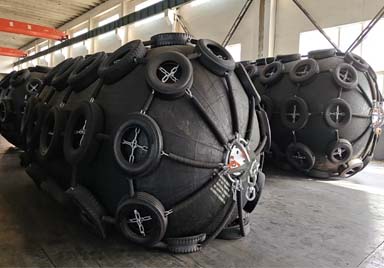
Each unit is fully finished after vulcanization, inspection and assembly. The outer surface is equipped with an integrated truck-tire protection net composed of used heavy-duty truck tires, chains and connecting hardware. The protection net stays permanently mounted onto the rubber fender body for anti-abrasion and anti-impact performance during ship-berthing service. All visual inspection, dimensional check and air tightness tests have been passed before dispatch. In fully inflated condition, the fenders occupy oversized outer dimensions which cannot fit inside standard container inner space, requiring standardized deflation and handling workflow for 40OT open-top transport.
Qualified technical operators perform step-by-step controlled deflation on each finished fender before lifting. The air valve is slowly opened to discharge internal compressed air gradually, avoiding rapid pressure drop that would cause abrupt rubber collapse. Internal pressure is reduced to a safe residual low-pressure status. A small amount of residual air is maintained inside the rubber bladder, which prevents sharp permanent folds, crease damage and rubber material fatigue caused by complete flattening. The entire truck-tire protection net, tire blocks and chain fasteners remain assembled on the fender surface during deflation. No disassembly of protective components is carried out, so the rubber surface is fully shielded against friction, scratching and local stress points in subsequent lifting and stowage steps.
The 40OT open-top container is positioned under the workshop overhead crane with its top tarpaulin and roof bows removed, leaving the full upper opening accessible for top-loading. Custom-designed lifting slings and chain sets connect to the dedicated lifting lugs embedded on both ends of each pneumatic fender. Lifting is carried out strictly in vertical orientation. Rolling, dragging, pulling across the ground or direct sling contact against bare rubber surface are strictly prohibited. The crane lifts each deflated fender steadily off the workshop floor, transports it directly above the open-top container aperture, and slowly lowers the unit into container interior under continuous supervision by on-site loading foreman.
Inside the 40OT open-top container, the two different sizes of pneumatic rubber fenders are scientifically arranged based on shrunk dimension after deflation. Units are positioned to avoid sharp extrusion and direct hard contact between rubber bodies. Soft cushioning materials are inserted into gaps between fender units and against container side walls to absorb vibration during ocean transit. Special lashing belts and securing chains are applied to fasten the whole cargo assembly firmly to container lashing points. This restrains lateral and longitudinal shifting, preventing collision, abrasion and deformation under vessel rolling and pitching at sea. Every stowage position is checked to guarantee no concentrated load acting on rubber bladder and tire-net connections.
Once all fender units are properly positioned, cushioned and fully lashed inside the 40OT open-top container, heavy-duty waterproof tarpaulin is laid evenly over the top opening. The tarpaulin is fully spread without sharp wrinkles, then tightly fastened along container side rails and corner fittings with tension straps. The tarpaulin provides reliable protection against rain, sea spray and dust during road haulage and port storage. After tarpaulin installation is verified, container corner locks and door locking bars are closed and secured. Customs-approved container seals are fitted on door locking devices to complete the whole loading operation.
Important Technical Reminder
Upon arrival at destination port, the pneumatic rubber fenders shall be unpacked and re-inflated strictly to rated working pressure in accordance with product operation manual. Visual inspection for rubber integrity, protection-net connections and air-valve sealing shall be completed prior to putting into ship-to-ship or ship-to-berth operation.


Copyright © Whale Marine Product Co.,Ltd. All Rights Reserved | Sitemap| Powered by 